The following is a sermon I wrote for a church community on October 6, 2024 for Matthew 4:1-11.
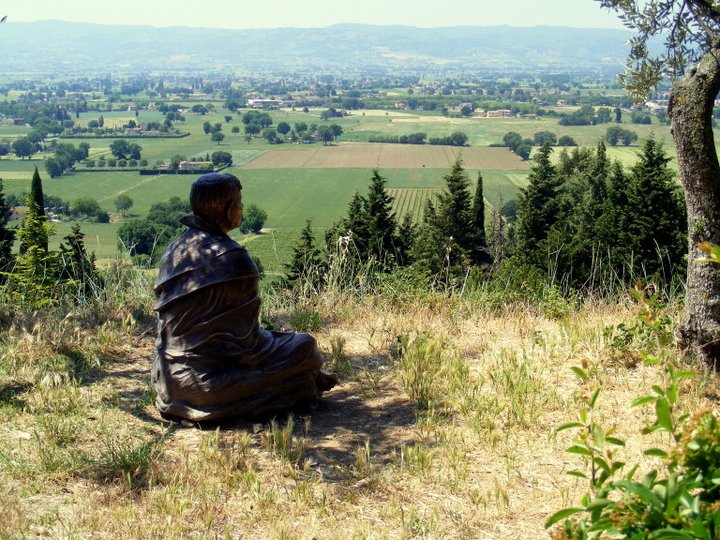
Good morning! Thank you for welcoming me back and for inviting me to preach on the weekend of St. Francis of Assisi’s Feast Day. This week’s theme is “beholding” creation. To “behold” something is to gaze upon or observe it. In Franciscan spirituality we call this contemplating creation. Fr. Richard Rohr writes about how this form of spirituality has its roots in the Hebrew Scriptures and that this practice is what formed the mind and heart of Jesus. A lot of people think that religion has to do with ideas and concepts and doing things in particular ways, but biblical spirituality is about getting to know God through the things that God has made.
St. Francis of Assisi remains one of the most beloved figures in the world because of his deep connection with creation. When I see garden statues of Francis, they often remind me of a “Disney princess,” his presence seems to beckon animals into his embrace, but this is a romanticized image of who he was. Francis spent considerable time contemplating creation, and his insights shaped not only how he saw the world but also how he saw his role within it. Francis is famously known for his Canticle of Creation, in which he lovingly refers to all creatures as his family. Family, whether human or nonhuman, are those we turn to for wisdom and support, much like we see in today’s Gospel.
In today’s Gospel Jesus is filled with the Holy Spirit and led into the desert, where He fasted for forty days. However, the “desert” here can be more accurately translated to “wilderness.” The wilderness likely wasn’t a barren place like the Sahara Desert, but more of an uncultivated region. It was a place uninhabited by humans and only produced food when there were abundant rains. Throughout Scripture, the wilderness is a place of intense experiences – of isolation, of renewal, and of powerful encounters with God.
It is in the wilderness that Jesus also encounters “the devil,” who presents Him with three temptations. Each temptation tests His identity as the Son of God. What kind of Son will Jesus be?
The first temptation is self-indulgence. The devil tempts Him to turn stone into bread. After fasting for forty days, bread would certainly be tempting. But in Scripture, “bread” is more than food, it also symbolizes material things. Jesus sees through this offer and reminds the devil that life is more than satisfying our immediate desires.
The second temptation feeds the ego, an offer of power. The devil showed Jesus all the kingdoms of the world and offered him all of their power and glory! This is the kind of power many would expect of a “Savior,” to seize political and military dominance. Jesus rejects this too, knowing true power lies not in domination but in service and love.
The third temptation is seeking external validation. The devil leads Jesus to the roof of the temple in Jerusalem, saying, “If you are the Son of God, throw yourself down,” and let the angels catch you. This invites Jesus to prove His identity with a miraculous display. Jesus resists once again, knowing that true identity and worth don’t come from external validation – they come from within.
These temptations – self-indulgence, power, and fame – are not unique to Jesus, they are temptations we also face every day. However, I don’t believe the temptations are coming from Jesus being in the wilderness, but it’s the wilderness that gives Jesus insight on how to overcome them.
Throughout history, people regarded the Earth as a manifestation of Divine Revelation, finding spiritual wisdom in creation. We also see Jesus finding solace in the garden by going there to pray and he used nature to share profound truths – his parables about the birds, the lilies, the vine, and the mustard seeds are only a few examples of how he used creation to share about who God is. It’s only fitting that the wilderness is where Jesus finds strength to overcome these temptations, because creation itself embodies the wisdom needed to resist them. Just as Jesus found guidance in nature, we too can look to the natural world for insight, especially in confronting the temptations that persist in our own lives.
The first temptation for self-indulgence is alive today in a society that chases the latest products, conveniences, and instant gratifications. We can have almost anything delivered to our doors, wrapped in layers of plastic, only to discard it soon after. These products and packaging end up in one of over 13,000 landfills across the U.S. One landfill in California spans 565 acres (that’s 427 football fields) and is almost 500 feet high. Landfills pollute our resources, harm wildlife and other humans, so is this ease of consumption really making us happier? After all, how much more discerning would we be if trash and recycling companies didn’t come to relocate what we discard every week and we were the ones who ended up with it? In contrast, when we observe the rest of creation we see that it thrives on balance – each creature takes only what it needs when it needs it and leaves no trace behind. We are the only species that disrupts this balance, but we can learn to live more harmoniously by becoming more conscious of our habits and working together to find creative alternatives.
The second temptation, to feed the ego, often shows up when we compare ourselves to others. Our culture encourages us to climb ladders of success, associating worth with power and wealth. But we also have a tendency to create our own hierarchies – we might compare ourselves to someone else’s success, to their beauty, to how smart they are… But in the wilderness, there are no hierarchies. Every being, every tree, every season plays a vital role in life’s balance. The value of a bird is no more or less than a spider just because one might feel scarier than the other. Similarly, we cannot compare our worth to someone else’s. Jesus embodied this in His ministry, especially in how He ate with people. His meals were not about status or power but about kinship. He embodied a “kin-dom” where power comes from care and service to one another to ensure everyone is a valued part of the family, much like creation’s web of life.
The third temptation is to seek validation from others. We see this in our celebrity-driven culture and with the rise of influencers. While it’s natural to want to be liked, our worth isn’t tied to another’s opinion. Take a moment to lift your wrist and trace your finger along the blue veins. We know that the iron in your blood was forged inside a star before the Earth was born. Your body is literally made of water and other Earthly elements. The fact that you exist is a miracle to behold. Every choice you make and the way you move through the world plays a significant role in this vast, intricate web of life. Our significance lies not in standing apart, but knowing we are part of something greater. As we see embodied in Jesus, true identity and worth don’t come from external validation, they come from within.
I invite you now to take a deep breath and bring your awareness into your magnificent body. Within you are 11 major organ systems that work in harmony without your conscious effort, your heart is beating, your lungs are expanding, your cells are regenerating. These processes, like the ecosystems of the Earth, are interconnected and vital, reflecting that same wisdom within us. It’s no wonder that research shows that people who feel more connected to the Earth report greater happiness and a stronger sense of purpose. Creation has the power to evoke calm, joy, and creativity. When we embrace these qualities, we need less, we compare less, and we seek validation less.
I think Jesus was simply facing these temptations in his own life and it was spending time in the wilderness that helped him to stay grounded in his identity. Let us be reminded that you too are filled with the Holy Spirit. You too are sons, daughters, and children of God. You too can overcome these temptations. When people are deeply rooted in their identity, grounded as part of this earthly family, these “devilish temptations” begin to fade away.
There is an abundance of wisdom in creation, waiting for us to discover it if we only step outside and be present to “behold’ it. What can we learn from trees that remain deeply rooted through the fiercest storms? From the slow unfurling of ferns, or the natural world’s graceful acceptance of constant change, letting go, and even death, in ways many of us humans struggle to embrace? St. Francis saw creation as family partly because everything is connected and shares a common home, but also because everything supports something else, much like family should. From creation, we can learn how to let go of limiting beliefs, how to embrace change, how to bloom, how to live in community, and ultimately how to understand our role within the web of life. The wisdom we find in the Earth isn’t something new or external to us – it acts as a mirror, reflecting the wisdom already within. Creation serves as both teacher and reminder, guiding us back to a truth that resides deep inside each of us. Just as we see balance, resilience, and interconnectedness in nature, these qualities are also intrinsic to our own nature, waiting for us to recognize and nurture them. When we nurture them and let go of false narratives we write about ourselves, when the temptations fade – what’s left? Love.
While preparing to write this sermon, I walked a path into a small wilderness area behind where I live. Sitting beneath a fir tree, I took in the wildness of my surroundings – the scurrying of squirrels, the swooping of birds overhead, the rustling of acorns and other debris that came tumbling to the ground. But even during the calm of these moments, I heard the rush of cars from the nearby I-5 highway, a sound that usually fades into white noise but suddenly seemed much louder as I sought quiet. It made me reflect on how our wild spaces are shrinking, being tamed and becoming less accessible for the sake of our “convenience.” This transformation not only impacts the Earth’s habitats and health but further distances our connection to her.
I say this with full inclusivity to trans and nonbinary folks – when a mother carries a baby, her body is food, shelter, and life. Even after the child is born, her body remains a source of nourishment and care. As the child grows, they eventually come to understand the vulnerability of their own mother, and this realization brings a shift in their relationship. We come to see that our mothers cannot care for us endlessly; there comes a time when we must care for her too. In the same way, the Earth is our food and shelter. She supports our physical and mental well-being. She is our life. But she is also vulnerable when we constantly take from her without giving back. To have a truly healthy relationship, we must remember to nurture the one who has always nurtured us. I recognize that we are in great need of national policies that protect the dignity of our planet, but I urge you not to wait for those changes to come. Never underestimate the power of individual actions and habits, how they shape not only the world around us but also who we become as we grow.
I’d like to leave you with a few questions for thought:
1. What lessons can you learn from creation that might help you navigate your current challenges?
2. How can you contribute to nurturing the Earth, just as she has nurtured you?
3. Where in your life can you embrace more balance and interconnectedness, like the rest of creation does?
As we celebrate the Feast of St. Francis, let us be reminded that we are part of this beautiful, interconnected family of creation. Just as Jesus found strength in the wilderness and St. Francis found wisdom in every creature, may we open our hearts to the lessons of the Earth by beholding creation too. May we embrace our role not as conquerors of nature but as stewards, siblings, and caretakers. Let us nurture this relationship so that our presence on this Earth is a blessing, not just to ourselves, but to all beings who share this common home. May we find strength in our roots, beauty in our fragility, and purpose in our interconnectedness.

 nichole marie
Leave a comment