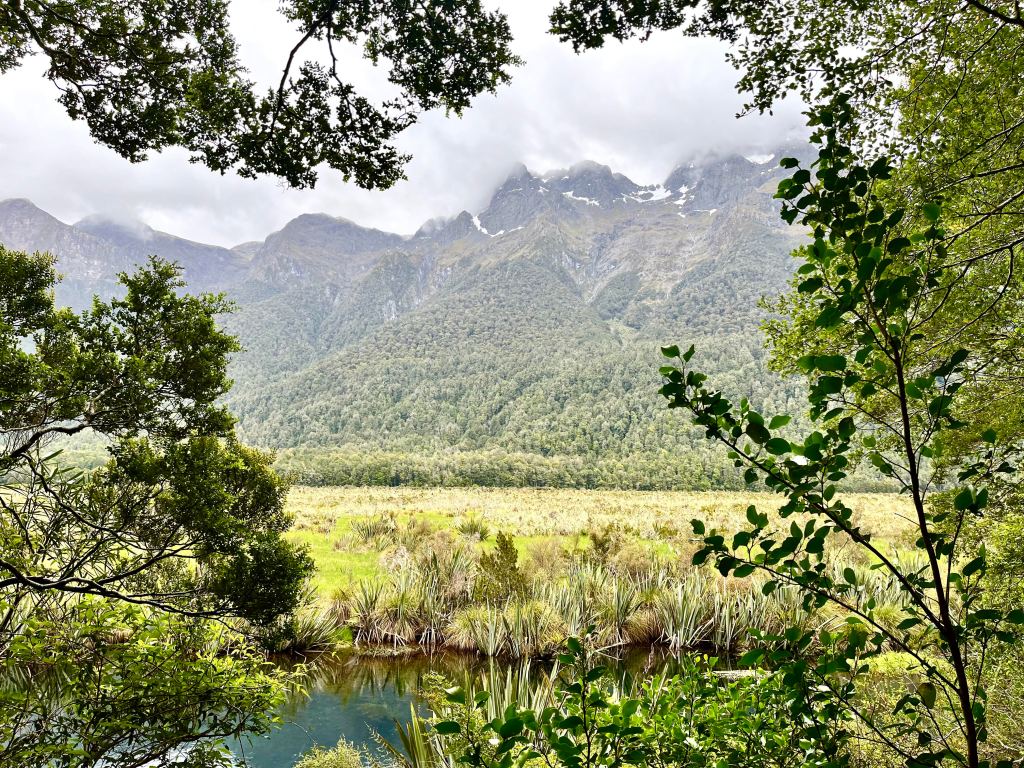
When I was in New Zealand two years ago, my friend Hayden and I went for a hike through one of the rainforests. What was only supposed to take 30 minutes took us over an hour because I kept stopping to admire all the trees and lush moss. At one point the thick beds of green between the trees moved me to say, “It looks so soft that I could sleep in there.” Hayden replied, “No, you can’t touch the moss.” When I asked him if the moss wasn’t good for humans, he replied, “Humans aren’t good for the moss.”
Whoa. His response was humbling and invited me to reflect deeper about what it means to live in harmony with creation. It’s not about what nature can offer me, but how I belong to this wider web of life.
On my most recent visit to New Zealand, we stopped at a cafe near the base of a hike. The cafe’s seating seemed to grow out of the small hill it sat on. The tables and chairs were made from recycled tree stumps and tucked along the slope. The hill itself wasn’t paved over with cement. Humans worked with the land rather than forcing it to conform. It wasn’t easy to get a good photo, but it was beautiful.
Throughout the trip, I noticed how little concrete I saw. In the cities there was, but outside of them were a lot of gravel roads, paths, and trails that let the Earth breathe. Roads were often only two-way and narrow, tightly hugged by greenery on both sides. There weren’t any street lamps on those roads, deterring us from driving in the dark. The result of no street lamps also left the natural world undisturbed by constant light.
Even small choices felt intentional. Many products came in compostable packaging, even things like potato chip bags. A brunch spot we went to offered tin takeaway cups, and guests would return the cups after using them. It wasn’t just about reducing waste; it felt like an invitation to participate in something bigger.
Hayden’s response to me that day was simple and shouldn’t have been so profound. Humans aren’t good for the moss. It made me think about how often we approach our needs and self-care in a way that feels “good” to us but ignores the dignity of our broader family – the soil, the trees, the water, the creatures who share this home. The truth is that anything that isn’t good for the environment isn’t good for us either. We aren’t only meant take care of creation but recognize that we are an integral part of it. When we are present to the Earth, noticing how She moves and breathes and lives, we learn more about how to live in harmony with Her too.
Maybe another way of putting it is I’m thinking more about the difference between being ecocentric and anthropocentric. An ecocentric mind is about valuing nature for its own sake while anthropocentric values nature for the material and physical benefits that it provides to humans. I don’t think an anthropocentric mindset is sustainable when we depend on the world around us. How differently would many of us live in the US, both towards the Earth and each other, if we built our communities around nature, rather than through it? If we hadn’t paved over so much for the sake of convenience; if while building, we considered the dignity of creation in the process?
Perhaps it’s less about learning and more about remembering. There was a time when humans relied on the rhythms of the Earth to guide them. A time when life moved at a slower pace. A time when we created more than we consumed.
What if living in harmony with creation isn’t about stewardship from above but about belonging within? What if it’s less about managing nature and more about remembering that we are nature, too?

 nichole marie
Leave a comment